






Introduction
Welcome to Explore Greece with eat2explore! In this lesson plan you’ll find ways to incorporate history, literature, geography, cultural studies, art, music, and more as we take you on a multi-subject tour of the Hellenic Republic, all while enjoying delicious foods from Greece.
How to Use This Lesson Plan
We’ve suggested a schedule for days and subjects, but this is your lesson plan! Follow the plan we’ve presented or change it up to make it work for your family.
Read the entire lesson plan before you begin. Some subjects overlap to provide a deeper understanding of the country as a whole. Follow the links for awesome online resources!
(If you find a broken link, please let us know so we can update our lesson plan.)
Read through the Cultural Guide from your eat2explore box. Make your shopping list for the fresh ingredients you’ll need for the week.
You can bring together reading, writing, listening, and hands-on activities to make this an adventure to remember!
We’ve included book links so you can explore more! Many of these books will also be available at your local library, and some are on Amazon Kindle for free.
You can find more information on how to get the most out of your eat2explore box by clicking this link to our educational blog post.
Are you ready to begin your eat2explore adventure? Let’s get started!
MONDAY
Geography & Science
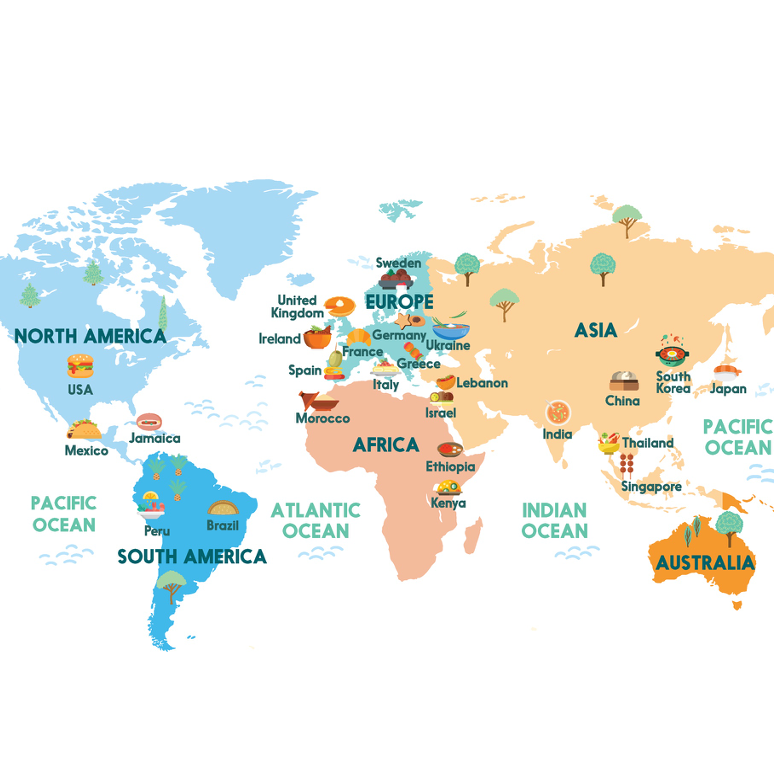
- Where is Greece located? Southeastern Europe; bordering Albania, Republic of Macedonia, Bulgaria, and Turkey
- What water bodies surround Greece? The water bodies that surround Greece are the Ionian Sea, the Aegean Sea, and Mediterranean Sea. The Sea of Crete and Thracian Sea are both a part of the Aegean Sea whereas the Aegean Sea is a part of the Mediterranean Sea.
- How many Greek islands are there? The Greek Archipelago has about 6,000 islands and islets scattered in the Aegean and Ionian Seas, of which only 227 islands are inhabited. Popular islands include Santorini, Mykonos, Corfu, Milos, Naxos, Crete. (Fun fact - the movie Mamma Mia was filmed on location at the small Greek island of Skopelos)
- What is an Archipelago? An expanse of water with many scattered islands.
- Online resources:
- The Geography of Greece at EduPlace
- Geography Lesson About Greece on Haiku Deck
- Geography and Early Greece video on YouTube
Explore more! How did the geography of Greece affect trade for the country?
Science experiment:
Read about how Archimedes learned about buoyancy and displacement. Use a bowl of water and different items to find out if they sink or float. Then measure how much water is displaced for each item!
Time to Cook! - Chicken/vegetable Souvlaki
- eat2explore Curriculum Guide for Greece
- Go to page 3 for how best to enjoy this recipe as a family
- Learn fun facts about dill and tzatziki
TUESDAY
Language Arts & Literature
- We use the Greek alphabet in our day-to-day communications without even realizing it!
- Fun fact: The word “alphabet” actually comes from the first two letters of the Greek alphabet: alpha and beta.
- Greek letters are used in both science and mathematics, and are also used to name college fraternities and sororities.
- The first 3 letters of the Greek letters, α (alpha), β (beta) and γ (gamma) are used in trigonometry as variables for angles.
- Alpha
- 1st letter in Greek alphabet
- In Math, alpha is the first angle in a triangle
- In Science, radiation comes in three levels of exposure - alpha particles, beta particles and gamma rays. Alpha particles are the least dangerous in terms of external exposure.
- In “slang” definition, alpha personality refers to a dominant person or their behavior
- Beta
- 2nd letter in Greek alphabet
- In Math, beta is the second angle in a triangle
- In Science, radiation comes in three levels of exposure - alpha particles, beta particles and gamma rays. Beta particles are electrons that move very quickly -- that is, with a lot of energy.
- In “slang” definition, beta personality refers to reserved, responsible and moderate person; your average Mr Nice Guy, nothing spectacular but likeable enough!
- Gamma
- 3rd letter in Greek alphabet
- In Math, gamma is the third angle in a triangle
- In Science, radiation comes in three levels of exposure - alpha particles, beta particles and gamma rays. Gamma rays are the most dangerous form.
- Delta
- 4th letter in Greek alphabet
- In Math, delta represents differentiation in calculus.
- In Science, delta is used to represent a change in science - "a small change in" a quantity.
- Pi
- 16th letter in Greek alphabet
- In Math, the letter pi represents 3.14 in mathematics - the value you get from dividing the circumference of a circle by its diameter. 3.14 x diameter = circumference
- Fun fact - There is a Pi day! Celebrated every year on March 14th around the world. Find out more at Piday.com
- Rho
- 17th letter in Greek alphabet
- In Math, rho represents the density of an object. Rho is also used in spherical polar coordinates to represent the radius.
- Sigma or
- 18th letter in Greek alphabet
- In Math, upper case sigma (Σ) is used for "sum" and lower case (σ) is used for the standard deviation of a population measure in statistics.
- Omega
- 24th and last letter of the Greek alphabet
- In Science, omega measures electrical resistance - the unit for resistance is ohms (Ω) and the angular velocity of an object rotating on an axis (ω).
- Learn the Greek letters and write them using our activity sheet. Try spelling your name or write a secret message in code!
Explore more! Why did scientists and mathematicians decide to use Greek letters in their studies and research?
Read about Greek Numbers! Can You Count in Greek?: Exploring Ancient Number Systems
WEDNESDAY
History
The official name for Greece is the Hellenic Republic and its capital is Athens.
- Wednesday, March 25 (Greek Independence Day)
- March 25 commemorates the start of the War of Greek Independence in 1821 - to be free from the Ottomon Empire. Greek Independence Day | History, Date, & Traditions
- The national flag of Greece is referred to as "I Galanolefki," meaning “The Blue and White.”
- The flag is white and azure blue.
- The white cross symbolizes the nation’s Orthodox Christian religion.
- The flag has nice equal horizontal stripes of blue and white.
- The azure and white stripes represent the nine syllables in the Greek motto, “Freedom or death”.
- The cross in the upper left hand represents the country’s deep roots in orthodox Christianity.
- It was officially recognized by Greece as one of its national symbols on December 22, 1978.
Explore more! Why is Greece called the Hellenic Republic?
The Olympic Games originated in Greece. The most common date of origin is believed to be 776 BC.
- Why did the Ancient Greeks participate in Olympic Games? Originally, there were no athletics, but instead the four-year religious festival celebrated Zeus. The early Greeks added sporting events to showcase their best athletes. These ancient games lasted until nearly 400 AD
- Where and when were the first modern Olympic Games held? Athens, Greece in 1896
- How often are the modern Olympic games held? The Summer and Winter Games were held every four years with a few exceptions until 1986. Then, the International Olympic Committee (IOC) decided to alternate the Summer and Winter Games. Now we get to watch Olympic Games every two years!
- When was the last time the Games were hosted by Athens? 2004
Discuss your favorite Olympic sports from the summer and winter games. Write a story about a famous Olympian.
Online resources:
Olympics For Kids video on YouTube
Time to Cook! - Baked Greek fish
- eat2explore Curriculum Guide for Greece
- Go to page 4 for how best to enjoy this recipe as a family
- Learn fun facts about fennel and Alaskan Pacific cod
THURSDAY
Social studies/Cultural studies
The Greeks have a long and proud heritage centered around their rich history dating back to the Bronze Age and Orthodox Christian celebrations.
What percentage of Greeks are Orthodox Christian? 98%
What are some major celebrations in Greek culture?
- Greek New Year is celebrated on St. Basil’s Day and often involves baking a cake, called a vassilopita, with a coin hidden inside to bring good luck.
- Holy Week and Greek Easter begins with the Aprokies celebration and concludes with Easter Sunday featuring roasted lamb and boiled eggs.
- Celebrations of the Saints, called panigiria, occur throughout the year, especially in the summer.
Famous Greeks with links to biographies and other interesting facts!
- Hippocrates-The Father of Medicine
- Euclid - Mathematician
- Socrates - Philosopher
- Alexander the Great - Soldier, Explorer, Conqueror
- Archimedes - Scientist, Mathematician, Engineer
- Pythagoras - Mathematician
- Plato - Philosopher
- Cleopatra - Ruler of Egypt (although she was born in Egypt, she was actually Greek!)
- Homer - Author of the Iliad and The Odyssey video on YouTube
Learn about the life of one of these famous Greeks and locate their birthplace on the map..
- Online resources
- Museum of Modern Greek Culture virtual tour
- Ancient Athens 3D
- Incorporate some fun and try making togas at home while discussing the philosophy of Socrates, Aristotle, and Plato. Get dressed up and practice reading some famous (and inspirational) quotes - Quotes from famous Greeks
Explore more! How did Ancient Greek culture influence the world?
FRIDAY
Art & Music
Mythology in Art
Ancient Greece is famous for its mythology. The stories of the gods and goddesses entertain us with antics and drama. You can find many pieces of art showing scenes from Greek myths including paintings, vases, statues, and more.
- Online resources
- Greek Mythology Crafts for Kids has fun and simple craft ideas
- Art History and Artists of Ancient Greece
- Greek Vases at the British Museum
- Ancient Greek Art at the Metropolitan Museum
- Go for a virtual tour of ancient Greek wonders. Now that more museums are online, it is easier than ever to go exploring (from home) - Kids’ Discover Ancient Greece
Greek Music
Listen to authentic Greek music while you cook!
- Online resources
Time to Cook! - Greek “lamburger”
- eat2explore Curriculum Guide for Greece
- Go to page 4 for how best to enjoy this recipe as a family
- Learn fun facts about cucumber and lamb
Other Reading Resources
Greece: World Cultures Through Time
Ancient Greece and the Olympics
D’Aulaires’ Book of Greek Myths